By Gary Deters
Through years of research and observation we know that some grasses are better than others for drought, shade, disease resistance, spring greenup, and many other desirable qualities (Figure 1). For instance, choosing a drought tolerant grass can save a lot of water while the aesthetics and the function of the lawn remain good, especially during drier conditions.

Minnesota homeowners often struggle to maintain their lawns when water is scarce during dry weather conditions, and city watering restrictions that prohibit irrigation can make this even more difficult. Adding to the challenge is the use of Kentucky bluegrass as a standalone lawn species. While Kentucky bluegrass is very popular, it is not known as a drought tolerant grass, which makes it difficult to manage during dry conditions. Furthermore, certain areas in the Twin Cities metro area have sandy soils, which have very poor water retention, leading to more frequent watering, possibly clashing with a city's watering restrictions.
Twin Cities residents can significantly reduce water use on their lawn by using drought tolerant mixtures of grass species. While this recommendation is easy to make, it is difficult to implement. The concept of using turfgrass mixtures is to provide genetic diversity, leveraging the positive qualities from each species to help to prevent widespread damage from environmental conditions, turfgrass diseases, or pests.
As an example, using a mixture of tall fescue and Kentucky bluegrass can cover several advantageous qualities of each species, while offering some protection for their unfavorable qualities. Kentucky bluegrass is known for its attractive appearance, early spring green-up, winter hardiness, and traffic tolerance, but typically needs more water and fertilizer to keep a healthy looking appearance and is quite slow to establish from seed. Tall fescue is best known for its strong drought tolerance, dark green appearance, faster seed germination (Figure 2), and traffic tolerance, but has a slow spring green-up, and it is susceptible to snow mold and ice damage. So in this case, a mixture of the two species would be the best choice for those that want a drought tolerant and green looking yard that has protection from extreme environmental conditions.
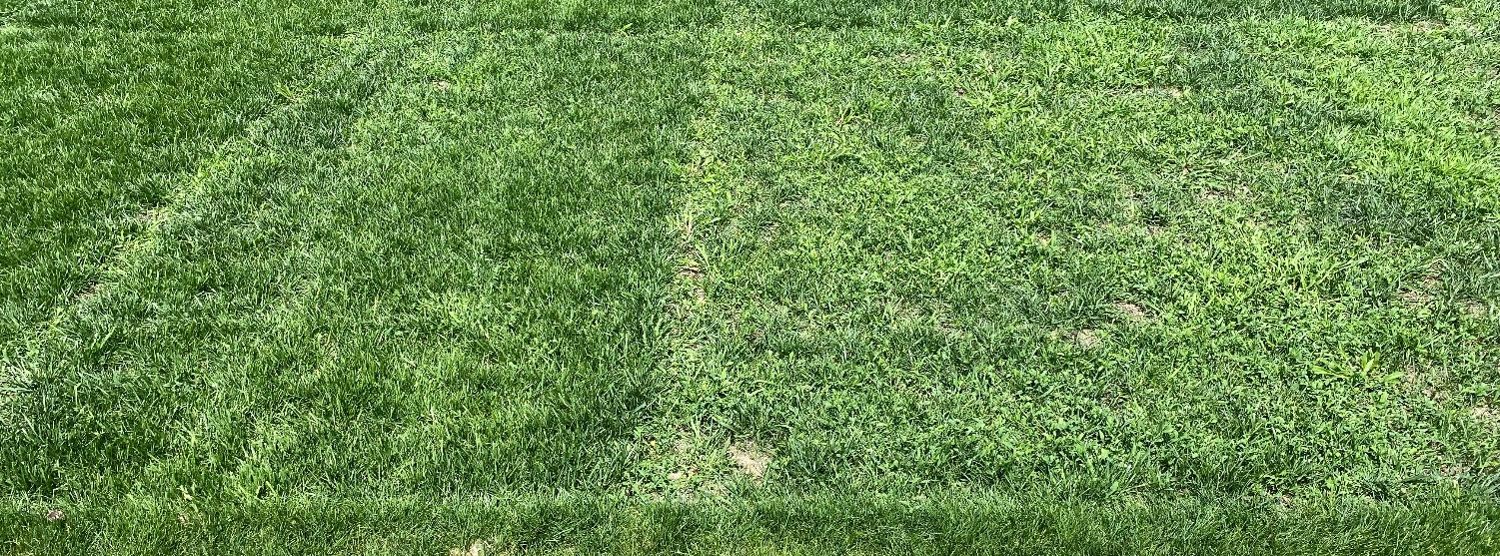
Each year many Minnesotans find themselves in situations where they need to reseed or re-sod large areas of their lawn. When this decision is faced, UMN Extension resources can be an excellent place to learn best practices and get recommendations. The “which grass should I buy?” question is the one that is most difficult to get answered. While UMN researchers can provide recommendations on species, and point residents to lists of cultivars that have done well in our area, there is not an easy and straightforward way to recommend specific seed mixes that residents can easily find. To improve this situation, we are initiating a new, coordinated, multi-year effort at four Twin Cities sites to develop data-driven seed mixture recommendations.
The result of the collaboration will hopefully lead to seed mixture recommendations that can easily be communicated to the public by local and state agencies and available from seed retailers around the Twin Cities and beyond. This should lead to more homeowners and municipalities using drought tolerant mixtures that can save water and perform well under extreme weather conditions.
All four research sites will be seeded in August of 2025, and performance evaluations will take place in 2026 and 2027. Once established, the research plots will not receive any supplemental irrigation and the best performing mixtures will be chosen.
In the meantime, for all of your lawn care questions, visit the UMN Lawn Care Extension website to learn more about lawns. If you are looking specifically for information on how to choose the best grass seed for your lawn, see our Buying turfgrass seed for Minnesota lawns blog.
This project is supported by the Metropolitan Council as part of our collaboration to reduce water use on Twin Cities lawns.